
Keepa Keepa Dreaming
In the early 2000's Andrew Macdonald worked in collaboration with the Keepa Keepa Elders Group to develop strategic plans, articulate and document key initiatives, and support the preparation of submissions that contributed to securing government funding.
Keepa Keepa Eagle Place
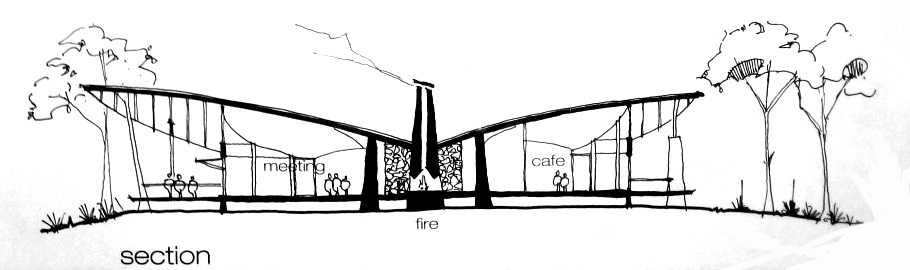
The designs below are by EJE Architecture working with the Aboriginal Elders of Lake Macquarie
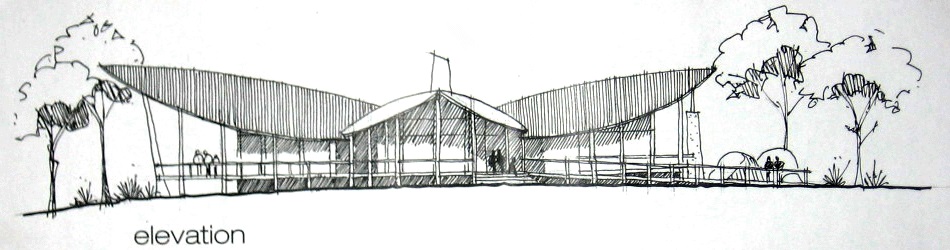
Keepa Keepa Eagle Place was the life long dream of Aboriginal Elder Uncle Bob Sampson (RIP) Farewell Uncle Bob Sampson
The above image depicts the plan for Aborigial Centre Uncle Bob planned to build at the Keepa Keepa site.
For now the idea resides in the dreamtime along with Uncle Bob.
Keepa Keepa Cultural Place is located next to Mount Vincent and is located in New South Wales, Australia.
This area is described as the "Eagle Eye" of the landscape, this is because of the panoramic view of the areas surrounding Lake Macquarie that can be seen from this lookout. It is reported that the elders that come up to Keepa Keepa have a special feeling about the place. The more time they spend here the more they are finding out about the place and how the area was used by Aboriginals prior to European settlement.
There are number Bush Foods, medicinal plants and useful plants in this area. Rob Sampson helped to survey the area and map out a bushfood trail to use for educational purposes for visitors to Keepa Keepa. Some of the bushfoods seen in this area include Apple Berry (billardiera scandens, Burrawang, Settles's Flax (gymnostachys anceps), number Acacia spp,. Bracken Furn, Kurrajong, Mat Rush (lomandra longifolia), dianella caerulea and Native Grape (causonis clematidea).
Keepa Keepa Community Projects (August 2006)
Keepa Keepa Indigenous Reserve and Cultural Centre Project Plan
Keepa Keepa Trifold - Promotional Document
Keepa Keepa ICC Funding Submission Summary
Virtual Sourcebook for Aboriginal Studies in the Hunter Region
Keepa Keepa Elders - Beliefs and Respect to the Land - Keepa Keepa Elders Group - August 2006
When the great ancestors roamed the earth, they existed as human, animal, and bird all at once, in a time when all natural things were in unity. These ancestors were unlike the people of today. They possessed special knowledge and were intimately connected with particular animals and plants.
As they journeyed across the land, their actions shaped the world, forming the rivers, mountains, and landscapes we see today. The land they created is now occupied by their descendants. Aboriginal people are the inheritors of this land, passed down from the great ancestors. The land is ours because we belong to it; the blood of our people was spilled there, and this binds us to place.
The spirits of our ancestors remain with us still, watching over the land and its people.
The traditions passed down through thousands of generations carry the stories of creation — of animals, of people, and of how to care for the land and all living things through harmony with the environment. This is the foundation of our spirituality. The land provides for our physical and spiritual needs. The land does not belong to us; we belong to the land.
The Keepa Keepa Elders Group recognises the importance of land to all Aboriginal people, and to the wider community of the Hunter region. The group is guided by a strong ethical foundation and seeks to support stakeholders in working together toward a sustainable future for local forest environments — ensuring social, cultural, and economic benefits for the whole community.
The State Forests of the region are a significant public asset, providing a wide range of benefits. Forestry NSW has embraced the principles of ecologically sustainable forest management and continues to work alongside Keepa Keepa and the broader community in response to their needs, values, and expectations.
While different ways of accessing and using forest resources can at times create conflict, a collaborative approach enables stakeholders to address challenges openly, respectfully, and constructively. This approach emphasises mutual accountability, clear communication, honesty, and trust.
The Keepa Keepa Elders Group represents a diverse range of interests and is committed to building and strengthening relationships to ensure shared benefits for all parties — and for the land itself — now and into the future.
Statement of significance of this area to Awabakal Traditional Descendants
It must be recognised that the significance of place to Aboriginal people does not rely solely on the presence of physical evidence such as artefacts, grinding grooves, scarred trees, or other visible markers. While these tangible elements provide important connections to Ancestors and serve as reminders of cultural practices that guided everyday life, they represent only part of a much deeper relationship.
These physical traces allow people to engage with history — to see and, where appropriate, experience the places and materials shaped and used by Aboriginal communities over thousands of years. However, they do not define the full extent of cultural significance.
From a broader community perspective, it is evident that, in today’s environment, cultural heritage can be undervalued through limited understanding, disconnection, or an over-reliance on what is physically visible. What has endured for thousands of years risks being diminished under modern development pressures and narrow interpretations of significance.
The importance of land cannot be defined solely by what is tangible or measurable. It also resides in knowledge, memory, and continuing cultural connection. For Aboriginal people, this connection exists because their Ancestors walked the land, and this alone affirms its significance.
The Awabakal people have cared for this area for countless generations as part of their Traditional Country. In the present day, it is both appropriate and necessary that Awabakal descendants continue to be actively involved in the protection, preservation, consultation, and management of this land. Their involvement is essential. To exclude or overlook this role risks undermining both the integrity of decision-making processes and the wellbeing of the land and broader community.
This land holds stories and knowledge that remain vital to Aboriginal identity. Cultural heritage, in all its forms, is important — whether represented by a single artefact, a scatter of materials, or an area with no visible physical evidence. All are significant. All are relevant.
Equally, places may hold deep cultural significance without any physical markers at all. Cultural value cannot always be seen, measured, or formally designated. Yet current systems do not always recognise this. At times, processes intended to protect cultural heritage instead contribute to its loss, through incomplete understanding or an over-reliance on visible evidence.
For this reason, it is critical that cultural heritage is understood in its full context — not only as physical remains, but as a living connection between people, place, and identity.